1,000 Square Feet on Orcas Island: A Chef's Home in the San Juan Islands
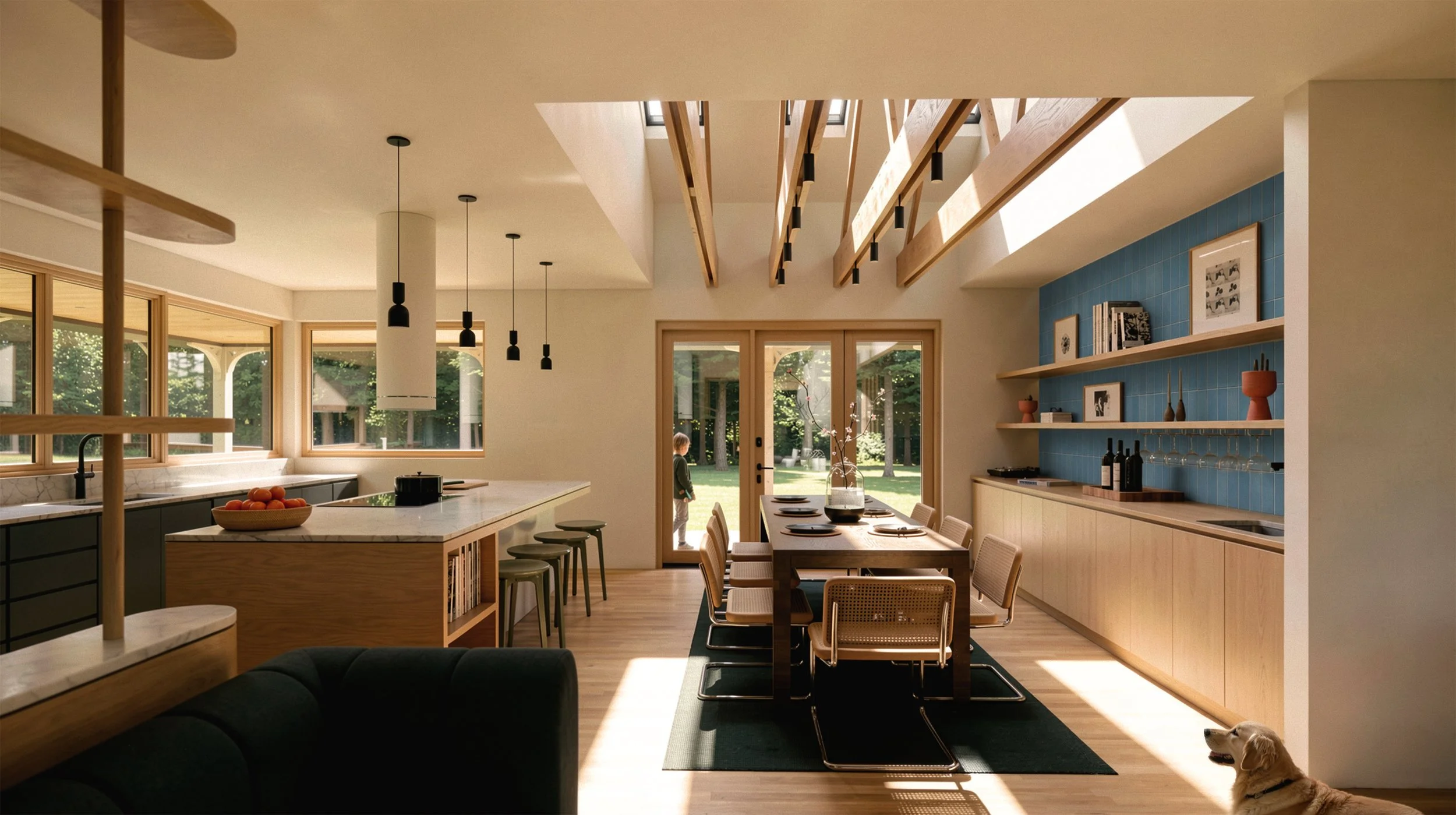
Case Study: When the footprint is fixed at 1,000 sq ft and the client is a professional chef who entertains constantly, every decision has to pull double duty.
A 1,000 square foot home does not give you the option of inefficiency. Every room has to do more than one thing, and the spatial moves that work in a larger house - the transition corridor, the separate formal dining room, the mudroom that exists only to be a mudroom - become liabilities. You strip them out and figure out what actually matters.
For this project, the answer was clear from the first conversation: the clients are a family of three who entertain constantly, and one of them is a professional chef. Everything else follows from that.
Putting the Kitchen in the Middle
The original layout kept the kitchen at the perimeter - a standard arrangement that treats cooking as something that happens before you come to the table. The redesign moves the cooktop to a central island, which accomplishes several things at once: it brings the chef into the room, allows face-to-face interaction while cooking, and makes the island the social anchor of the entire main floor rather than a piece of furniture in a kitchen.
Along the exterior wall, the remaining kitchen program - cold storage, prep surfaces, built-in pantry - is organized into flush, floor-to-ceiling cabinetry. Appliances and infrastructure are integrated and concealed. The counter stays clear. In a small house with a serious cook, visual clutter is a real problem, and cabinetry that requires discipline to maintain is not a solution.
A second full bathroom - a practical addition for a family that entertains - was introduced without expanding the footprint.
The Porch and the Light
The original house had an 8-foot deep wraparound porch that was doing relatively little for the interior. The redesign treats it as an opportunity: large glass multi-slide doors replace the original wall at the porch edge, connecting the interior directly to the outdoor space and dramatically extending the visual boundary of the main living area.
Three skylights were introduced above the dining area, introducing direct overhead daylight to a part of the room that previously relied on the perimeter windows. The stripped ceiling reveals the existing roof trusses - exposed rather than covered over - adding volume and visual interest to a room that gains both from not having a dropped ceiling plane above it.
The house reads larger than it is. Not because it was designed to deceive, but because the available light and the outdoor connection do what square footage normally does.
More on how we approach projects in the San Juan Islands on our island architecture page.
PROJECT INFO
Location: Orcas Island, WA
Type: Residential Remodel
Architecture: Field Report Architecture
Structural Engineer: Sweeting Structural Design
Year: 2023–2024
The brief here - designing a kitchen for a professional chef - comes up in a different context in Designing Haerfest.